
The Circle in the Square (Doctor Who)
(Content note: This post references childhood sexual abuse, the objectifying male gaze, and the repression and processing of traumatic events in general.)
Given that, let’s start with something really abstract. A symbol, and a pretty basic one as far as symbols go. A circle, circumscribed by a square. Simple geometry. And the Circle in the Square is by no means a hugely important or influential symbol in Western esoterica – it’s minor enough to take some digging to uncover, and what’s uncovered isn’t exactly consistent. Which, you know, is kind of part and parcel for abstract symbols.
The first thing that might come to mind is a problem of geometry – “squaring the circle” refers to creating a square of the same area as a given circle, using a finite number of steps with only a compass and a straightedge. It was eventually  mathematically demonstrated to be an impossible problem, which is actually kind of delightful given the subsequent esoteric usages — for if such fusion is technically impossible, its success is necessarily transcendent, pointing to Ascension. Anyways, in basic symbolism, the Circle represents the infinite, the cyclical, the eternal, totality and perfection. The Square, on the other hand, represents material reality, the four corners of the earth, and subsequent limitation. As such, the Circle in the Square can represent a “union of opposites,” if you wish, or at the very least the immanence of the divine.
This basic analysis makes sense of the Masonic use of the symbol – and we should note that the primary symbol of Masonry consists of a square-edge and compass, used for making squares and circles. Anyways, as W.L. Wilmshurst describes in his 1922 book The Meaning of Masonry, “Deity, symbolized by the all-containing circle, has attained form and manifestation in a ‘square’ or human soul. It expresses the mystery of the Incarnation, accomplished within the personal soul.” This, we should note, isn’t just divine immanence (as opposed to a Manichean separation of the earthly and the sacred), but is specifically rooted in the human experience. Wilmshurst goes on to liken the metaphorical squaring of the circle to a kind of “regeneration,” an “ascension into heaven” that accompanies the “necessity of self-dying—not, we repeat, the physical death of the body but a mystical death-in-life of everything except the body” which is fundamental to understanding the esoteric mysteries.
 There are also sources like Elliott Wolfson’s Circle in the Square, which delves into the symbolism of the Kabbalah, and specifically into its gender implications. According to Wolfson, the Circle (with its curviness and suggestion of a hole) actually symbolizes the female, while the Square symbolizes the male, with the placement of one in the other not only suggesting union (alchemical or otherwise) but a particular hierarchical relationship.
And yet, despite such inconsistencies and problematic implications, there’s nonetheless the same underlying principle at work, namely the integration of what are seemingly, if not opposites, non-overlapping magisteria. Which is not unlike what Doctor Who does for a living – namely, smashing together disparate genres in new and interesting ways. …
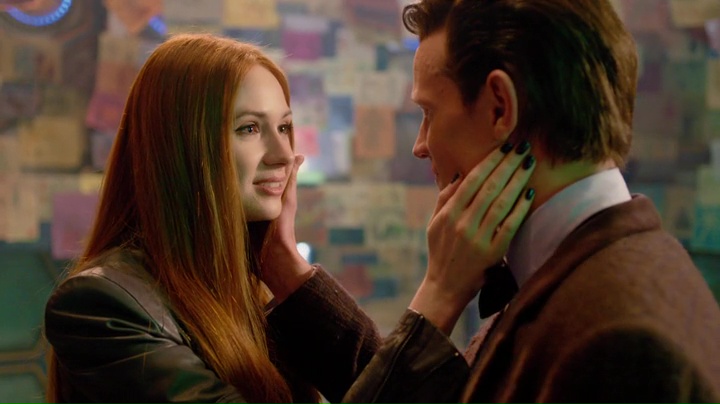 Last week we talked about the expression of the Beautiful throughout the history of Doctor Who, and gleaned different kinds of aesthetics employed by the show in the process – from awe at new, strange places… to the banal objectification of women… to an almost ritualized praise of monsters in the modern era. And it’s this latter sense of beauty that I find most interesting, given how monsters are now used in Doctor Who, especially in the Moffat era. Because monsters are no longer just villainous plot devices for generating scares. Quite often they are secret protagonists, and weighted with symbolic value, especially when juxtaposed with our main characters such that they become telling metaphors. This latter process I call the “monstering” of a character, and of particular interest to me is how Amy Pond becomes consistently monstered during her time on the show.
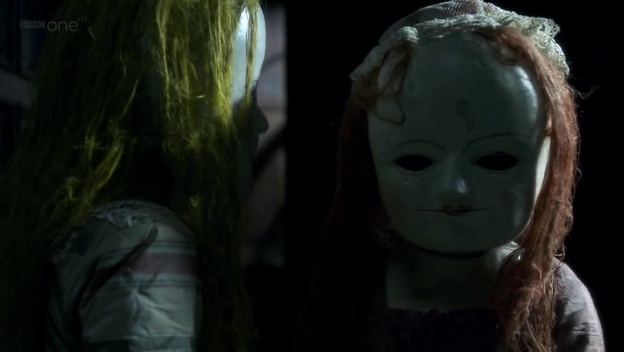 Contrast this with the monstering of Amy in Night Terrors. In Night Terrors, we see Amy transformed into a deadly Wooden Doll, the product of a child’s nightmare, a child who’s afraid of being abandoned. …