
Blood Makes Noise (E.V.O. The Search for Eden)
 Arguably the most Hegelian moment in all of video games, at least in an aesthetic sense, comes at the start of E.V.O. as the player’s avatar – at this particular moment in the game a fish – meets a jellyfish and is welcomed to the dialectical process of evolution. The jellyfish explains the three rules of evolution: fight for survival and for food, only move forward never back, and evolve and become strong. At which point the dialogue ends, the player bites the jellyfish in the head twice, and then eats the juicy roast his corpse converts into thus regaining some health and gaining experience. The process reiterates until eventually the player evolves into a human being, defeats the monstrous Bolbox, and reaches Eden where he is finally allowed to become Gaia’s consort and bring about civilization.
It is, to say the least, one of those games that stops you short, critically speaking. Its psychochronographic space is a British coast, expanding endlessly the closer you look at it. Every detail is strange, the explication of one leads inexorably to another. There is too much meaning here; in every direction lies rabbit holes to topple down.
And yet at its core this is an almost obvious game. Evolution is a more or less inevitable thing to pair with an experience system, and I’m sure prior art exists, although this is the earliest instance of it I’m aware of. Everything else slots into place at least reasonably sensibly around the clever gameplay mechanic in a very classic function follows form bit of game design. Add the detail that it’s an Enix game (not from the Quintent sub-studio that produced ActRaiser and Soul Blazer, although it shared production staff with the former) and almost the entire thing clicks into place. RPGification of existing game styles was very much their thing, so of course the RPG side-scroller is a thing.
But it also helps explain the game’s strangest and most interesting aspect, which is its curious mishmash of an ideology and worldview. It has the characteristic slight obliqueness of a Japanese game – a phenomenon we’ve discussed previously – and the tendency towards slightly distorted and cracked mirror versions of European cosmologies, a tendency emphasized by the slightly dodgy translation in E.V.O. In this case the player is shepherded by Gaia, a personification of the Earth, who is apparently the direct daughter of the Sun. But this is laid alongside an almost-sensible version of evolutionary biology – one that’s not even close to scientifically accurate, but that has at least seen a science textbook at some point in its life. And then on top of that there are Martian bird people perverting the course of human evolution.
The Martian bird people in many ways distract from the real strangeness here, which is the attempt to merge the eco-hippy rhetoric that Gaia is being plucked from with the pop-evolutionary biology, which, inevitably, gets simplified down to “survival of the fittest.” These are in some key regards a rough fit.…

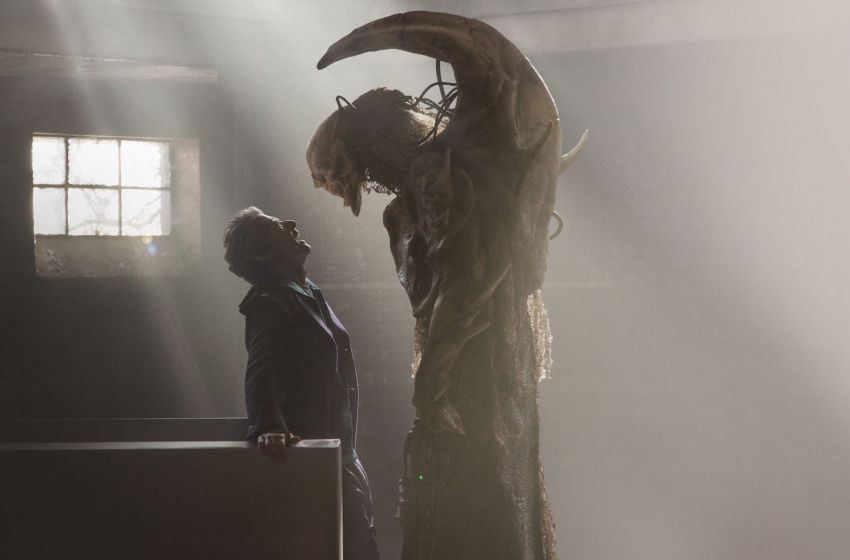 Well, that’s what I get for getting my hopes up about a Whithouse story I suppose. This was just crap. Unambitious, unimaginative, uninteresting crap made at best semi-competently. By some margin the worst episode of the Capaldi era, and saved from being Whithouse’s worst script only by the fact that
 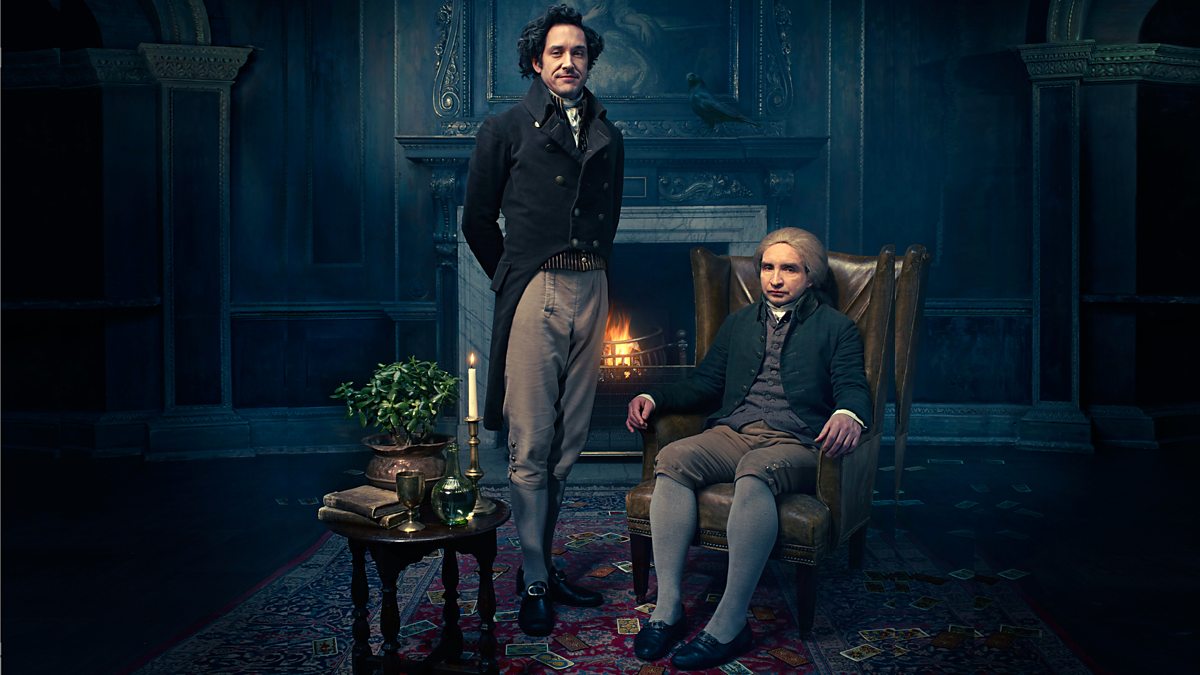 Or, as I really do think of the category, “all the stuff that’s probably going to lose to Star Wars,” a film I would be shocked to find on my ballot given my dislike for both the franchise and the director. Call me cynical.
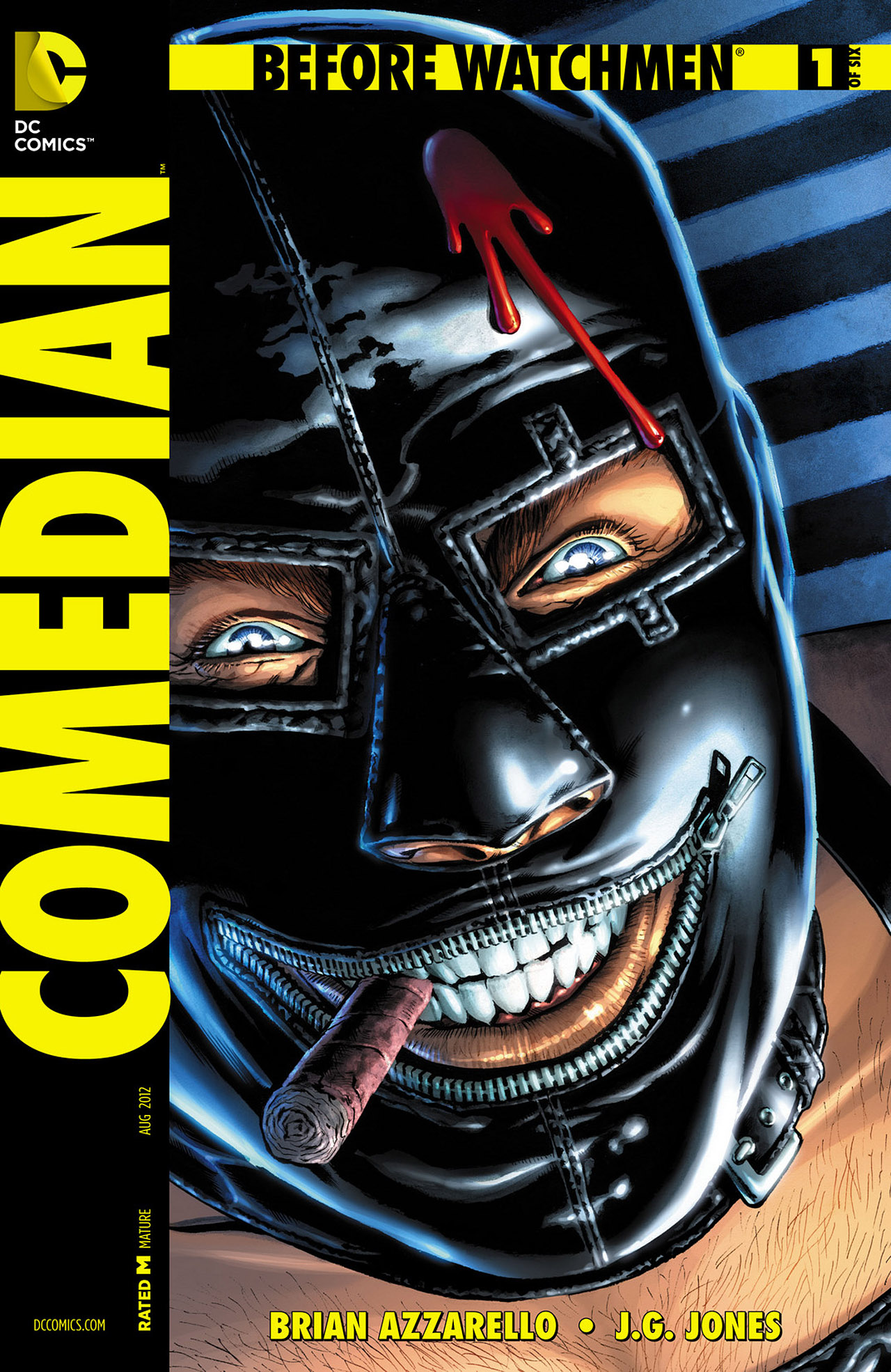 Previously in The Last War in Albion: Alan Moore and Grant Morrison’s differences of opinions are numerous, but one of the most fundamental differences comes in their relationship to the atomic bomb. Both were profoundly concerned with nuclear warfare, but for Morrison it was a childhood fear he found respite from in superheroes, whereas for Moore it was an adult concern he worked through using superheroes as a metaphor.
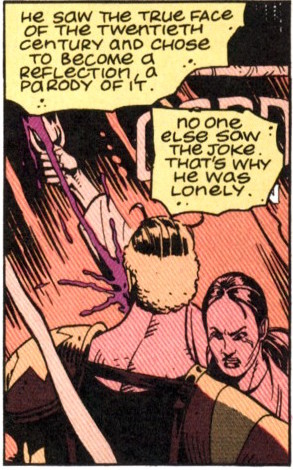 Arguably, then, this forms one of the few major chinks in Moore’s usually resilient armor of eternity – a point on which Moore can decisively and unambiguously be said to have changed. And yet it is easy to overstate this. Moore’s revulsion towards Watchmen is genuine, and yet it is not really a revulsion at the work itself. Rather, it is a revulsion at the world that Moore used Watchmen to look at – one that he found monstrous and twisted, and wrongly assumed that the rest of the world would see it that way as well. This is not just a matter of the fans who seized onto Rorschach in ways Moore found disturbing, but rather the entire way in which the nightmarish world he constructed, in which superheroes were the embodiment of humanity’s most self-destructive impulses tragically deluding themselves into believing that they were the world’s Watchmen and not its doom, was treated as something desirable.…
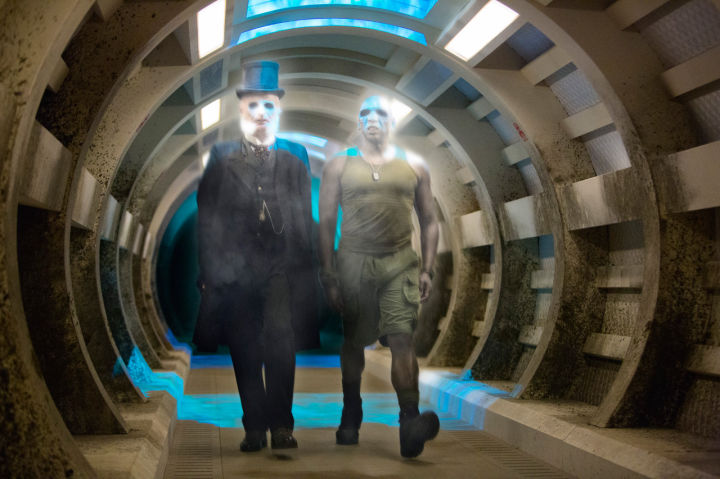 This week I’m joined by James Murphy of Pex Lives to discuss Under the Lake and, in typical Eruditorum Press style, a myriad of other topics, some of which actually have an obvious relationship to Under the Lake. Perversely, we manage to go on half an hour longer than Jane and I did about an actually good story. I have no explanation.
  Bit of an unplanned diversion for the Tricky Dicky series, this. Normal service to be resumed soon. (This series was always intended as a free-associating ramble.) We’re going to Shakespeare, albeit not in the way originally planned, so Spoiler Warning… um, for a play first performed about 423 years ago. Oh, and Trigger Warning, for discussion of recent violent acts, and some hardcore misogyny.
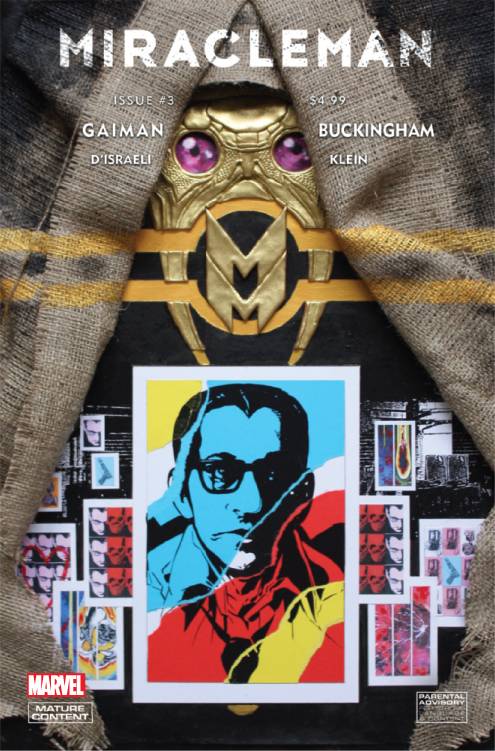 From worst to best of what I paid money for, sometimes reluctantly.
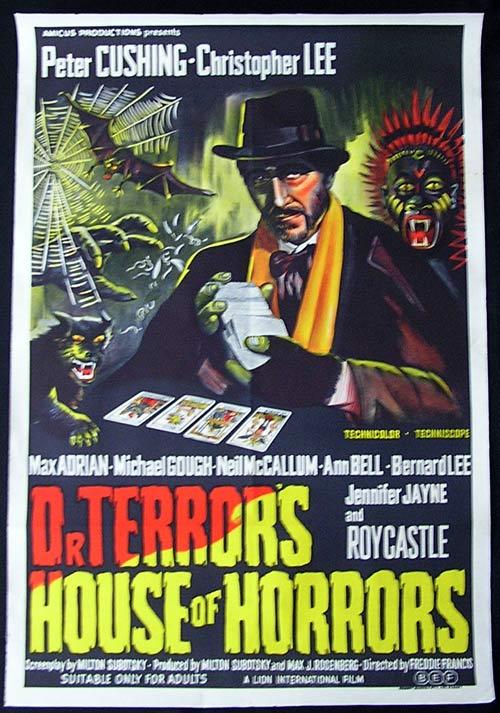 Along with Pex Lives itself and the Shabcast, one of the podcasts Eruditorum Press picked up when we took Kevin and James onboard was Holly Boson and James Murphy’s City of the Deadpodcast, which is looking at all of the releases from Amicus Films in turn. Readers of this site probably know Amicus best for the two Peter Cushing Dalek films, but on the whole they’re better known for a series of horror anthology films that James described to me as a sort of cut-rate Hammer Horror. Today we’ve got a look at Dr. Terror’s House of Horrors, a five-part anthology film featuring Peter Cushing as Dr. Terror instead of as Dr. Who, telling the awful fates of people on a train.