
She saw places that aren’t even there any more! (The Last War in Albion Book Two Part 12: Pax Americana)
_001-001.jpg) |
| Figure 885: The eight panel grid and recurrent figure eight motif in Pax Americana. (Written by Grant Morrison, art by Frank Quitely and Nathan Fairbairn, from The Multiversity: Pax Americana, 2014) |
Previously in The Last War in Albion: When it came out, Watchmen was generally hailed, along with Frank Miller’s Batman: The Dark Knight Returns as the vanguard for a more “mature” taken on superheroes – one marked by a great degree of cynicism and violence, an approach Moore would later come to repudiate, and that would lead him towards a profound ambivalence about Watchmen as a work.
It would be ridiculous to suggest that Moore did not want Watchmen to succeed, but equally, it’s clear that the terms on which it did succeed were intensely upsetting to him. In a fundamental sense, the book he wrote and the book people read were two very different things. And the gulf between those two versions of Watchmen is a huge and fundamental part of the reaction to the book.
It is also a gulf explored by Grant Morrison in his 2014 comic Pax Americana, part of his larger Multiversity series of semi-connected one-shots exploring alternate Earths in the DC Multiverse he had helped restore in 2007. The comic was explicitly modeled after Watchmen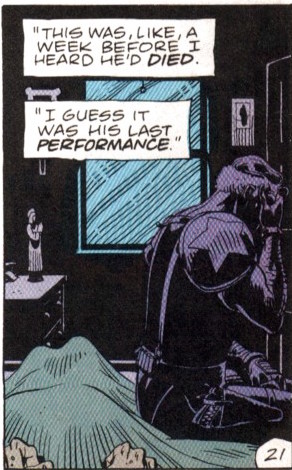 – indeed, Morrison had been hyping it since 2009, describing it as rooted in “that sort of crystalline, self-reflecting storytelling method” and an attempt to capture what would happen “if Alan Moore and Dave Gibbons had pitched the Watchmen now, rooted in a contemporary political landscape, but with the actual Charlton characters instead of analogues.” In this regard, what is perhaps most significant about it is that it is not an imitation of Watchmen as such. Where many comics overtly following from Watchmen adopt its nine panel grid, Pax Americana is based around an eight panel grid, albeit significantly more loosely than Watchmen is around its grid. This is in turn reflected within the comic, which uses the figure eight as a recurring visual motif. But Morrison slyly plays on the image, using it not just to represent the number 8, but as an infinity symbol, a figure that tacitly invokes Doctor Manhattan’s line shortly before the end of Watchmen, “nothing ever ends.”
_001-002.jpg) |
| Figure 886: An assassination in reverse. (Written by Grant Morison, art by Frank Quitely and Nathan Fairbairn, from The Multiversity: Pax Americana, 2014) |
Indeed, the complex notion of time implied by this iconography manifests throughout Pax Americana. Like Watchmen, it engages in considerable non-linear storytelling, but where Watchmen has a clear forward-moving narrative that runs from the beginning of issue #1 to the end of issue #12, albeit one punctuated by a number of clearly designated flashbacks, Pax Americana is simply told non-chronologically, with the reader left to piece together the actual sequence of events within the narrative. Its opening section, depicting the assassination of the President of the United States by the Peacemaker (shot in an open-topped motorcade, a tacit reference to Watchmen’s suggestion, made explicit in the film, that the Comedian was involved in the Kennedy assassination) in reverse over the course of three pages, a clear sign that this is not a comic with a straightforward relationship to time.…

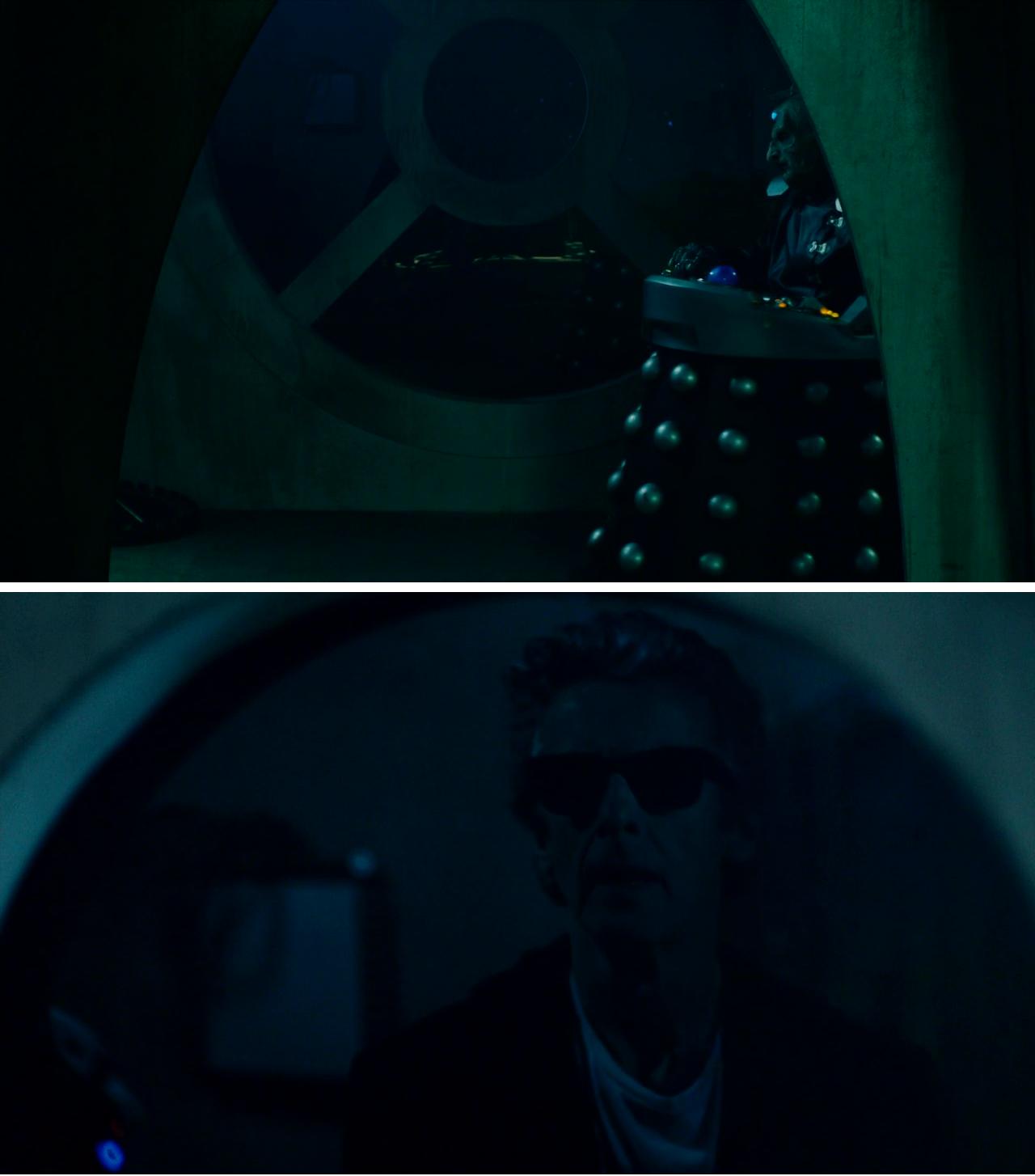
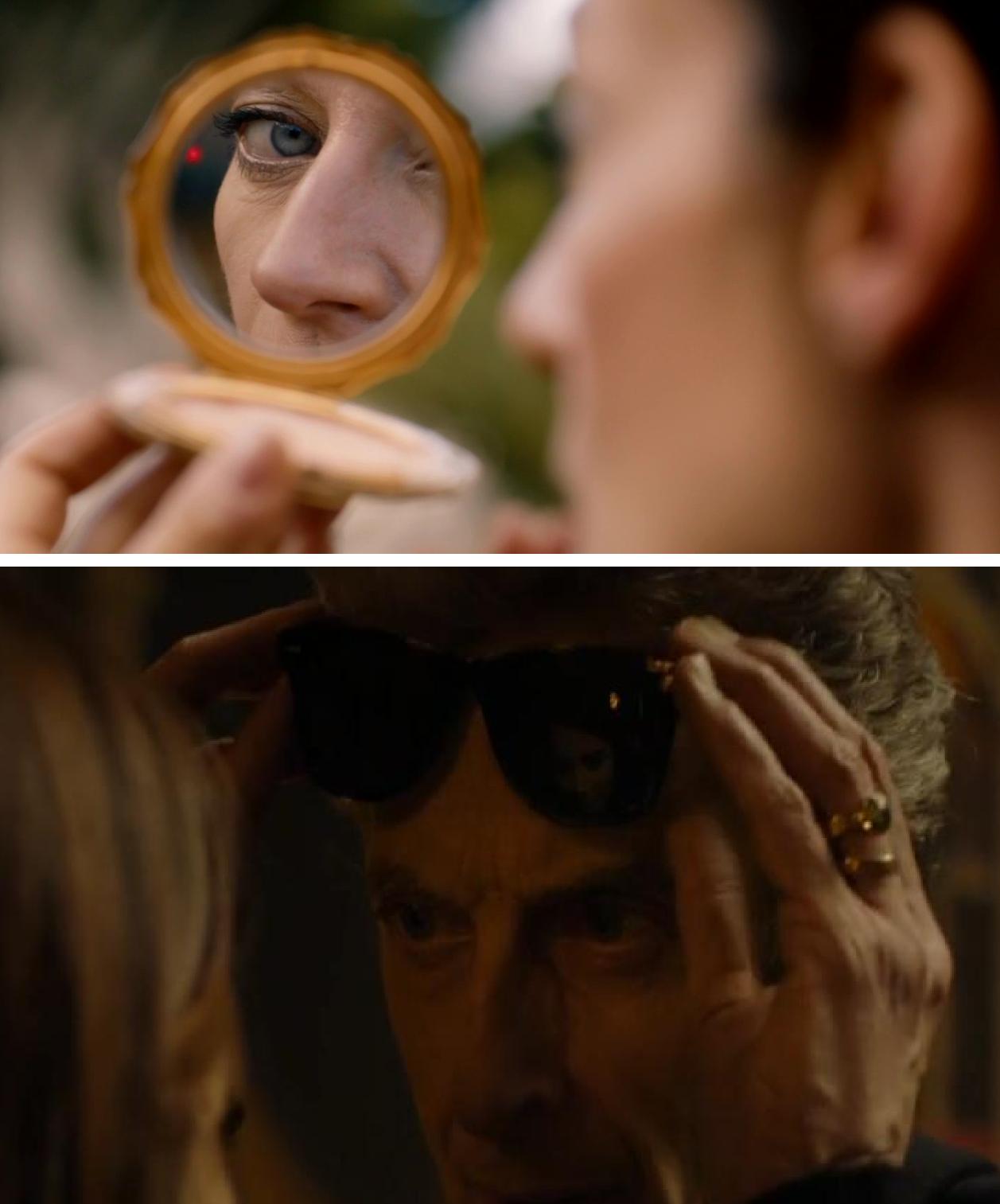 First and foremost, I look at the various mirror-shots within an episode as a skeleton key for unlocking my interpretations. So, for The Magician’s Apprentice we start with shots of Missy reflected in her compact, and Clara reflected in the Doctor’s sunglasses; in The Witch’s Familiar we have both the Doctor and Davros reflected in an eye-shaped window in the Infirmary on Skaro.
 Anyways, the word “apprentice” is rather interesting, given the new monster that appears at the beginning of The Alchemist’s Pupils (my title for the two-parter as a whole). Here we see Hands with Eyes in their palms, which is actually a rather ancient symbolic motif: the Hamsa, primarily from Middle Eastern culture, is considered a talisman that wards off or protects against the Evil Eye. It’s particularly notable for being a matricentric symbol to ensure a healthy and successful childbirth. But in this episode of Doctor Who the monster is demonstrably portrayed as malevolent, sucking a soldier down into the ground.
 As always, from worst to best of what I bought.
 1. Nostradidn’tus
 Hello, I’m Jane, your stewardess for the Lost Exegesis, a flight of fancy that explores the esoteric mysteries of LOST, an American TV show that ran on ABC from 2004 until 2010. It’s a show that had a significant impact on TV at the time, and still does to an extent.
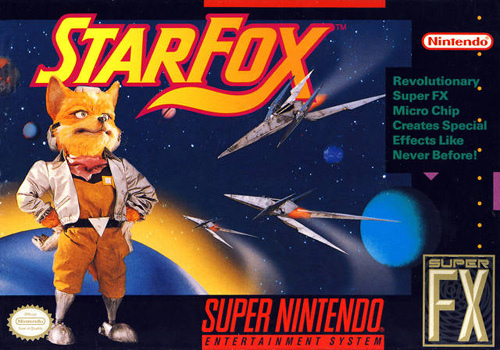 Quietly and behind the scenes, far from the watchful eyes of most of us, Nintendo was systematically fucking absolutely everything up. The long term result of this would eventually be the cataclysmic end of Nintendo’s dominance over the video game industry. The short term result was Star Fox.